The Process

From sketch to smart bin.

Recycla wasn't built in a day. It started as a SolidWorks model, grew through thousands of training iterations, and was validated against real waste data. Here's how we got from concept to a working prototype.

Phase 01

Hardware prototyping

Before writing a single line of code, we designed the physical bin in SolidWorks. The goal was a compact enclosure that could house dual sorting compartments, a servo-actuated lid mechanism, and an integrated camera and sensor bay — all while remaining manufacturable on a student budget.
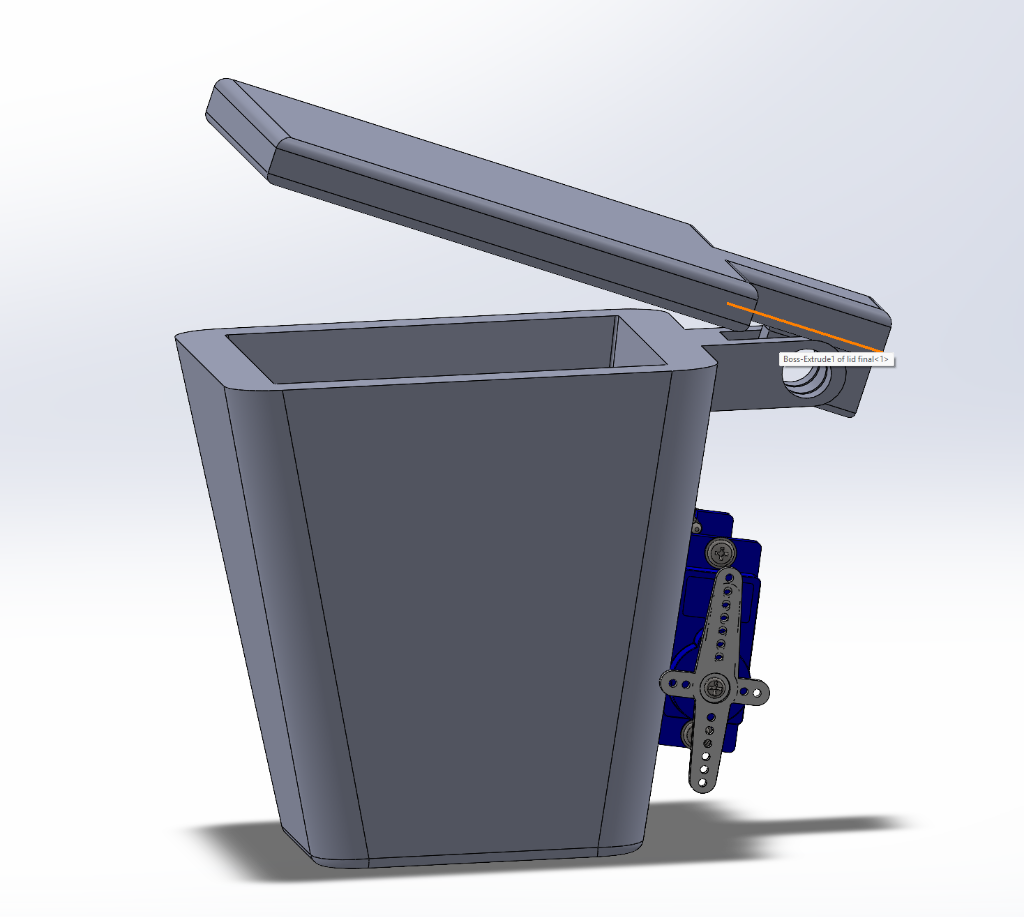
SolidWorks CAD prototype of the Recycla smart bin
Early SolidWorks prototype showing the tapered bin body, hinged lid with servo mount, and SG90 actuator placement

Design decisions

  • Tapered body geometry for structural rigidity and manufacturing simplicity
  • External servo mount with horn linkage for reliable lid actuation without internal interference
  • Hinge point positioned to allow full 90-degree lid opening for unobstructed waste insertion
  • Modular electronics bay designed to be removable for maintenance and iteration

The physical prototype went through three major iterations before arriving at the final form factor that balances structural integrity, component accessibility, and aesthetic simplicity.
Phase 02

Model training & validation

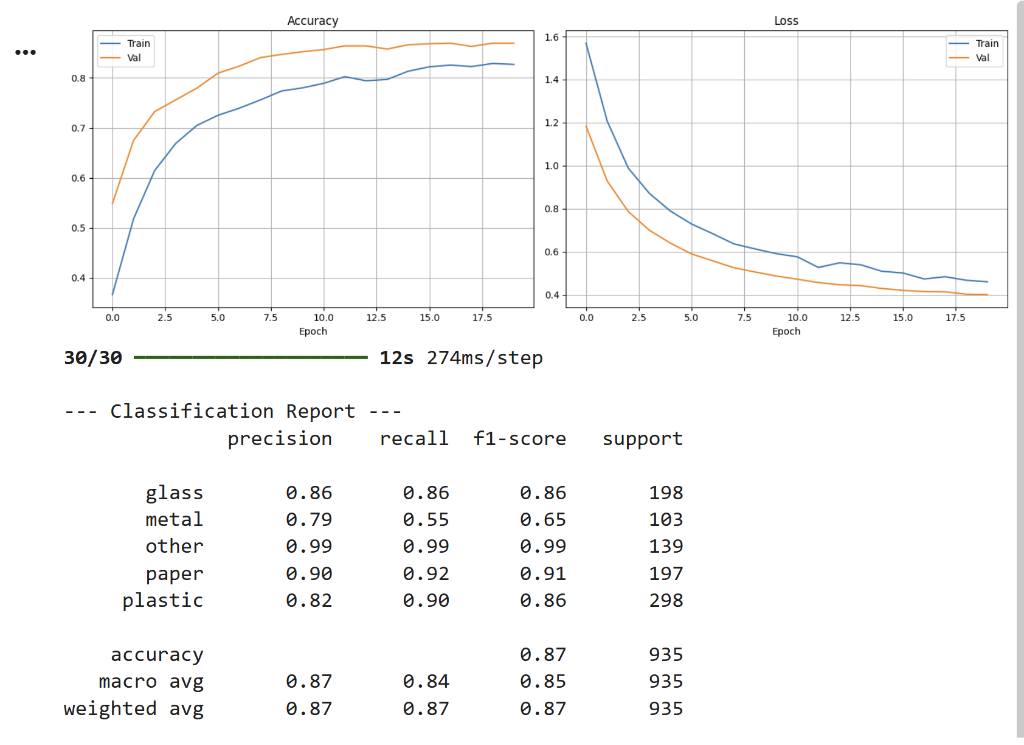
We trained a MobileNetV2 model using transfer learning from ImageNet weights, fine-tuned on a curated dataset of campus waste images across five material categories. The model was trained for 30 epochs with aggressive data augmentation to ensure robustness across lighting conditions and item orientations.

Training and validation accuracy and loss curves over 20 epochs
Training curves showing accuracy convergence at ~87% and loss reduction over 20 epochs, with per-class precision, recall, and F1 scores

Training results

87% Overall accuracy
935 Test samples
30 Training epochs
274ms Per step

Validation accuracy closely tracks training accuracy with minimal divergence, indicating the model generalizes well without significant overfitting. The classification report shows strong F1 scores across all categories, with "other" material achieving near-perfect precision and recall.

Phase 03

Error analysis

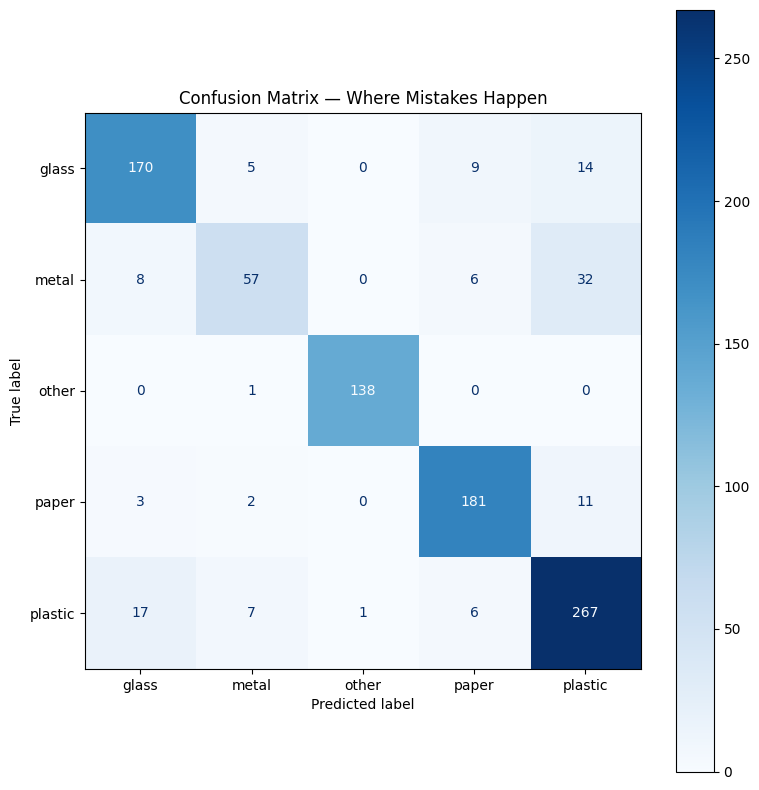
A confusion matrix reveals where the model succeeds and where it struggles. Understanding misclassification patterns is critical for improving the training pipeline and setting appropriate confidence thresholds for real-world deployment.

Confusion matrix showing classification performance across five waste categories
Confusion matrix across glass, metal, other, paper, and plastic — diagonal dominance indicates strong per-class accuracy

Key findings

  • Strongest performer: "Other" material at 99% precision — the model rarely confuses general trash with recyclables
  • Glass vs. plastic: The most common confusion pair, with 14 glass items misclassified as plastic due to similar transparency and surface reflections
  • Metal challenges: Metal shows the lowest recall at 55%, with 32 items misclassified as plastic — likely due to shiny metallic packaging resembling plastic surfaces
  • Paper reliability: 92% recall with 181 correct classifications, making paper one of the most reliably sorted categories

These insights directly informed our confidence thresholding strategy. When the model's confidence falls below 70%, the item defaults to garbage to prevent contamination — a deliberate trade-off favoring recycling purity over capture rate.

Open Source

Built in the open.

The full Recycla codebase — training pipeline, inference engine, and hardware control — is available on GitHub.

Recycla-Public

Classification pipeline, model training scripts, GPIO control, and hardware documentation.

View on GitHub

See the technology behind it.